
Scandinavian Christmas Ornaments: Traditional Straw, Wood & Paper Designs
Scandinavian Christmas ornaments are usually small and easy to touch. For example, you might see a goat made from straw, a wooden horse painted with flowers, or a paper heart resting on a fir branch. People enjoy making these ornaments just as much as they like how they look in the end. If you want your Nordic Christmas tree to feel special, pick a few items made from materials and traditions you truly appreciate. For the rest of your space, the following Scandinavian Christmas decoration ideas focus on greenery, windows, and table settings.
The word “Scandinavian” usually means Denmark, Norway, and Sweden, but this guide also includes the Finnish himmeli, which is a similar Nordic tradition. These ornaments are not the same for every country, and not all of them started out as tree decorations. Knowing their history makes them even more interesting and useful for decorating.
Straw: the Swedish Yule goat and Finnish himmeli
The julbock, or Yule goat, has a more unusual story than its simple red ribbon suggests. According to Nordiska museet, in Sweden, a goat once delivered Christmas presents. Later, Santa Claus took over this job, and now the goat is mostly known as a straw decoration. You can place a small one among the gifts or on a shelf instead of hanging it from a branch. If you want to display it every December, check that its legs are even and the straw is tied tightly.
The himmeli looks different in both shape and size. Its strands form light, geometric shapes that gently move. ThisisFINLAND says it is a traditional Finnish holiday decoration, usually hung above a dining table. A large himmeli works better there than on a crowded tree because it needs space for its shape and shadow to show. Rye straw is the traditional material, but modern versions use other materials too. Keep natural straw away from candles and hot bulbs.
Wood: folk craft, not just a neutral finish
Wooden stars and trees are common, but the Dala horse adds a real sense of Swedish tradition to a collection. This horse comes from the Dalarna region in Sweden and is a traditional folk craft, not something made just for Christmas. At Grannas A. Olsson, the makers say they cut the shape from pine and carve it by hand. The painted flowers on the horse follow the region’s kurbits tradition, which the workshop has continued sincethe nineteenth century.
One Dala horse is enough for a tree. Try placing it with plain paper shapes or unpainted wood so its pattern stands out. Larger horses look better on a mantel or sideboard. Before hanging a freestanding figure as a tree ornament, check its weight and the hanging hardware. For simple wooden items, look for smooth edges, a strong hanging hole, and a finish that fits how you store your decorations. Just calling something ‘wooden’ does not tell you much about where it was made.
Paper: Danish hearts worth making and keeping
The red-and-white julehjerte is a woven Danish Christmas heart, usually made as a small basket with a handle so it can hang on a branch and hold a small gift. There is an important difference between the common tree version and its earliest example. The Frederikssund Museum says that Hans Christian Andersen made a woven heart in the 1860s that had no handle and was probably not meant for a tree. It was green and yellow. This craft has a longer and more varied history than the usual red-and-white heart suggests.
To make a simple heart, fold two pieces of paper with rounded ends and cut equal slits in each. Weave the strips over and through each other to form the pocket. If you just lay the strips flat, the pocket will not appear. Once the weaving is secure, add a paper handle. Start with two colors of strong, flexible paper and a basic two-strip design before trying more detailed cuts. You can hang the finished heart on a tree, use it as a table marker, or fill it with a wrapped sweet. Keep the heart dry and store it flat or lightly stuffed to avoid creasing the loops.
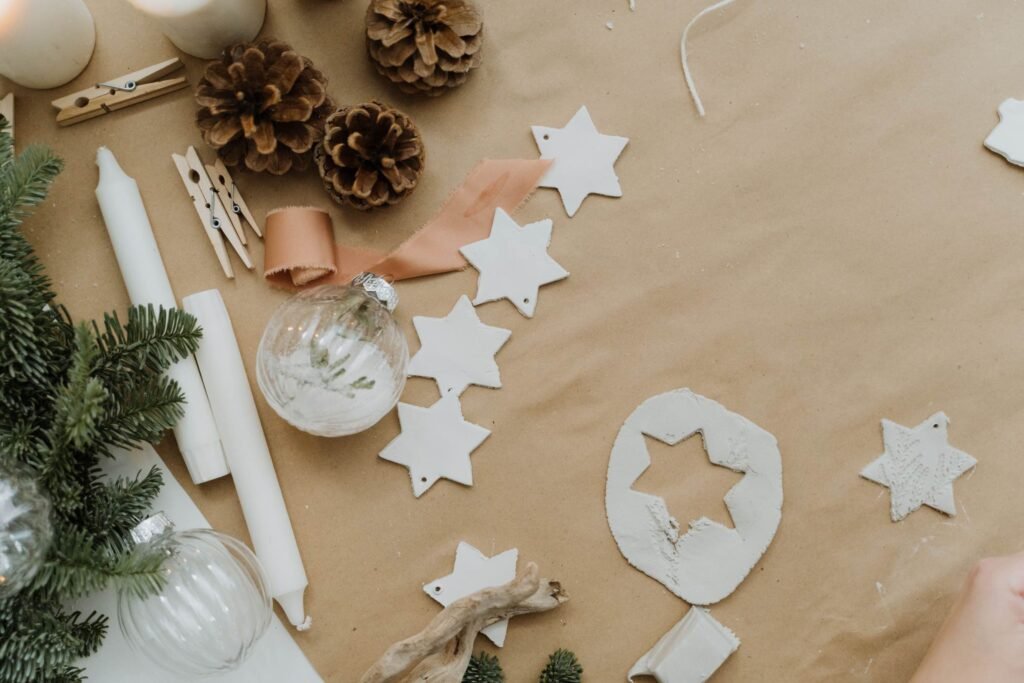
Paper stars and folded fans are also good choices. A pale star stands out better against a dark window than one hidden deep in a tree. Even though paper is easy to replace, a well-folded fan is worth saving between sheets of tissue paper to use again.
Where to buy: choose the craft before the shop
The pages below were current when this guide was written. Prices and shipping options may change, so check the listing before you order. The items listed are just examples and do not mean they are ranked or that every item is made in Scandinavia.
| If you want… | Seller and verified page | Check before buying |
| A Swedish straw Yule goat | Nordiska museet’s straw goat | The listed piece is about 26 cm tall and intended to stand under a tree; check shipping. |
| A Finnish himmeli with a lasting structure | Valona’s himmeli collection | These are contemporary birch-plywood interpretations, not traditional straw pieces. Check dimensions and mounting. |
| A Dala horse for a mantel or collection | Dalashop’s horse collection | Confirm size and whether the piece is meant to stand or hang. |
| A make-your-own Danish paper heart kit | Ugly Duckli’s woven-heart kit | Check delivery area; the kit makes hearts rather than supplying ready-made ornaments. |
You can also visit local Scandinavian craft stores and second-hand markets. If you want to find something vintage, check the glue, straw, and paper folds before buying, especially if the seller cannot prove its history.
How to bring the pieces together
Choose one material to use often and let the other two be accents. Attach about six or eight paper hearts to a small tree for a rhythmic look, and add a few wooden figures to give weight to the lower branches. Place a straw goat nearby and hang the himmeli above a table instead of putting everything on the tree. The mix of natural straw, pale wood, red paper, and dark evergreen is enough to create a complete color scheme.
You probably won’t collect the best items all at once. This year, make a heart, find a nice wooden piece next year, and keep the goat whose ribbon you retie every December. When the season ends, use these Christmas organizing tips to store your decorations safely. These small repairs and additions are part of the tradition.
Sources
- Nordiska museet: Christmas traditions in Sweden
- ThisisFINLAND: The original Finnish Christmas ornament
- Frederikssund Museum: The woven Christmas heart
- Grannas A. Olsson: Dala horse carving and kurbits decoration

Parker is a home and lifestyle writer at The Scandi Home, where they share a love for Scandinavian design, cozy living, and thoughtful interiors. Their writing focuses on simple, functional spaces that feel calm, warm, and lived-in.