
Scandinavian Christmas Tree: A Simple Nordic Styling Guide
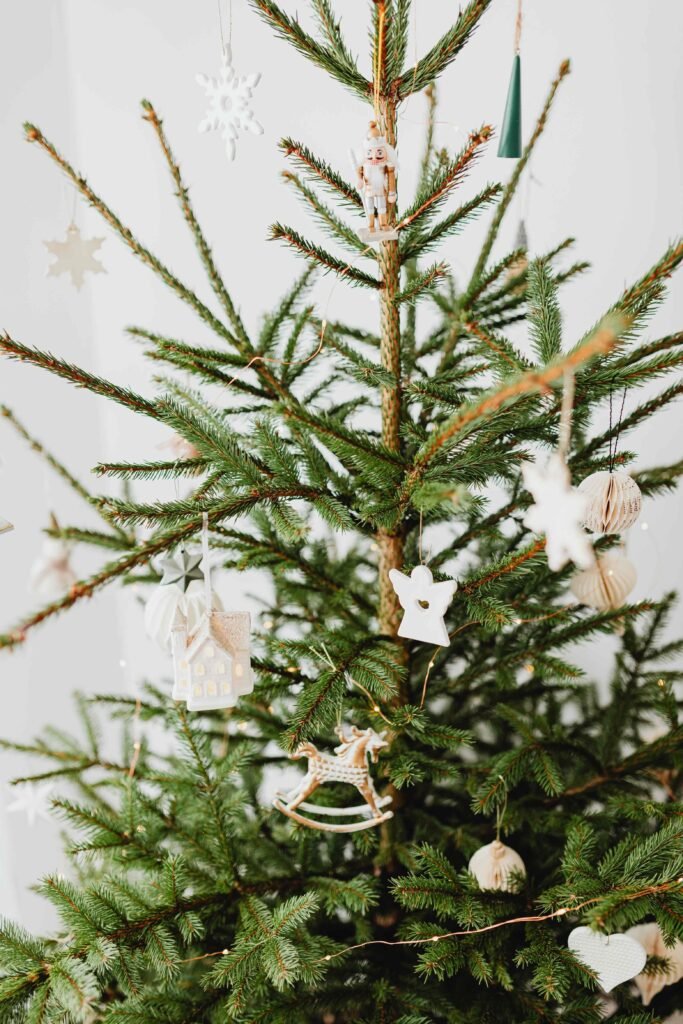
A Scandinavian Christmas tree uses fewer ornaments, sticks to a simple color palette, and features warm white lights and natural materials like paper, wood, straw, wool, and glass. The finished tree should feel festive and personal, with its branches still showing.
This matters because a minimal Nordic tree isn’t just about using fewer decorations. It’s arranged in layers with plannedgaps, so each star, heart, or wooden figure has space to stand out.
Key takeaways
- It’s better to choose a tree with a natural shape instead of trying to find one that is perfectly symmetrical.
- Stick to two neutral colors, use just one natural material, and if you like, add one accent color.
- Start by fittBegin by installing warm white lights and then move somemove a few of them closnearer to the trunk so as to give the scene morein order to add depth.
- Instead, opt for buying three sets of ornamental items rather than purchasing a large mixed set.
- Leave a space equal in width to that of a hand between most of the ornaments.
- To keep the tree from looking like a showroom display, include some handmade or collected items.
- It is not advisable to use real candles on a Christmas tree since battery-operated candle lights provide the same appearance in a safer manner.
What gives a Christmas tree a Scandinavian appearance?
Scandinavian tree decoration achieves a blend of simplicity and warmth by leaving the green branches visible instead of hiding them behind ribbons, floral decorations, tinsel and large baubles. The materials employed have a familiar, tactile feel, such as matte paper, unfinished wood, straw, linen, wool and clear or lightly coloured glass.
Although it is generally referred to as minimalist, the term ” cold minimalism does not capture the essence of the subject. A Christmas tree that has been thoughtfully chosen from the Nordic region can convey the spirit of the subject. A carefully selected Nordic Christmas tree reveals something about the people in the neighborhood; for example, a paper star that is a little irregular—a star. For instance, a paper star which is slightly uneven, one that has been broughttaken home from a journey—or one that has been made by a child all adds to the tree’strip, or one made by a child all contribute to the tree having individuality.
The idea that restraint and comfort go hand in hand is consistent with The Scandi Home’s philosophy, which states thata home can be calm, useful, and welcoming all at the same time; there is no need to imitate- one does not have to copywhat is in a catalog or get rid of all the bright colors, it is enough merely to have a clear editing rule.
The simplest rule is to repeat the quiet characteristics and concentrate on the personal ones.
Start with the right tree
Both real trees and artificial ones can be used; what is more important is concentrating on the shape and the spacing of the branches rather than looking at the label on the box.
Real tree
It is best to start with a spruce or a fir tree, ideally one with a slightly irregular shape; you should look for the gaps among the different layers; this is the best option to begin with; you need to look for the visible gaps between the various tiers of branches since the hanging paper decorations and the longer wooden ones require those gaps and demand that space.
When buying a tree, you should measure both the height of the ceiling and the greatest maximum width of the trunk. The distance you need to leave between the top of the tree and the ceiling will vary depending on the type of topper; for example, a 7-foot tree with a 14-inch star would not fit properly under an 8-foot ceiling.
When selecting a felled tree, you should takeYou ought to consider both the stand and the tree collar into accountwhen choosing a felled tree. The National Christmas Tree Association recommends that you cut straight through the trunk, put the tree into water as soon as possible, and check the stand each day to make sure that the water does not fall below the base.
Artificial tree
When selecting a tree, it is important to choose one that has a rangeChoose a tree which has a variety of needle shapes, obviousnoticeable brown branch stems, and sufficient space to hang the decorations; withenough space for hanging the ornaments; in the case of a tree that is heavily flocked, fewer decorations can be used because, without this, the snow effectsince, otherwise, the snow effect, the ornaments and the lights would all end up competing with both the ornaments and the lightsone another.
Take the time to shape it by lifting the inner ends upwards and outwards and then bending the outer ends in alldirections. From time to time, go back and check it. A compressed area is more distracting on a simple tree since there is less decoration to conceal it.
A small tree or branch tree
For an apartment a suitable choice would be aA potted fir, a tabletop tree, or a decoration made upconsisting of bare branches since this generally produces a more authentic Nordic appearance than havingwould be appropriate for an apartment and generally gives a more convincing Nordic look than a large tree placed in a corner. Ornaments that are lighter in weight should be selected so that the branches do not sag. Paper stars, small straw shapes, and thin wooden cutouts are ideal.
Choose a simple color palette before you decorate
It is hard to carry out editing if you remove all the ornaments at the first stage, so you should choose the palette while the boxes are still closed.
Try one of these combinations:
- Forest green, warm white, and natural wood are the safest choices and can be used once a year.
- In a conventional and quite plain style, with traditional and rather unshowy style using green, cream, and a soft red color: select brick, berry, or oxblood instead of a bright candy red.
- It is Green, white, and straw—light in color, having a rustic character, and is especially suitable for a smaller tree.
- It is glass of green and amber in color and has a brass finish: though it is warmer and a little more elaborate, it remains quiet when the metal is brushed rather than sparkling.
- A graphic and modern look is achieved with green, black, and pale wood; black should only be used for small accents so that it doesn’t sharply disrupt the wood.
A suitable proportion would be 70 per cent, that is 70 per practical ratio is 70 percent neutral, 20 percent natural material, and 10 percent accent color. There’s no requirement to count each item separately since this ratio stops red, black, and the 10 percent accent color from dominating or taking over. You needn’tprevents red, black, and 10 percent accent color. You don’t need to count every single piece. The ratio ensures that red, black or metallic tones don’t takekeeps red, black, or metallic tonnotes from dominatingtaking over.
If you put four items on a table—that is to say, on a table—specifically, namely, one paper ornament, one wooden or straw one, one bauble, and one made of thin wire—and if this assortment goes well together, then the. If this collection of four items goes well together, then the whole tree will too, the entire tree will generallyusually will too entire tree generally will as well.
How to decorate a Scandinavian Christmas tree step by step
Add the decorations. Decorate in layers and take a break at intervals. A tree that is kept simple is much more likely to be overdone if the entire process is carried out without stopping to look back.
1. Position and straighten the tree
Place the tree in a position where it can be seen and one that doesn’t obstruct where it’s visible without blocking a walkway, a door, or a heat vent. Orient the side of the tree that looks best towards the room, but there’s no need to go to great lengths to conceal each bare spot. Turn its best side toward the room, but don’t obsess over hiding every bare patch. A little asymmetry is usefulhelps.
Look at the tree from the sofa or the doorway you use most often. That is the view worth designing for.
2. Test the lights before they go on
Fit each. Plug in every strand onto the floor. Make sure that the wires are not damaged, the sockets are not cracked, and the connections are not loose. Rather than attempt to conceal the problem among the branches, replace the damaged set. Check for damaged wires, cracked sockets, and loose connections. Replace a damaged set instead of trying to disguise the problem among the branches.
It is advisable to use warm white lighting, and if the packaging states the color temperature, then this should be in the range from 2,200K to 2,700K. Lighting that is very cool white can cause wood, straw, and cream paper to appear grey.
3. Add lights from the trunk outward
Start from the bottom and proceed upwards. Begin at the base and work upward. Weave the wire near the trunk for a few inches, then move it towards the tip of a branch before bringing it back in. As a result, you get small patches of light at various depths rather than having a bright net of light sitting on the surface. This creates small pools of light at different depths instead of a bright net of light sitting on the surface.
Don’t bunch the bulbs. The U.S. Consumer Product Safety Commission advises using seasonal lights with proper safety features, following the manufacturer’s connection limits, and switching tree lights off before bed or when leaving home.
4. Establish three ornament families
Pick three groups that differ in shape or texture. For example:
- folded paper stars and hearts
- wooden figures or straw ornaments
- plain glass baubles in cream, clear, or muted red
Repeating three ornament families gives the eye something to follow. The decorations don’t need to match exactly. In fact, a mix of handmade and store-bought pieces usually looks better than a single boxed set.
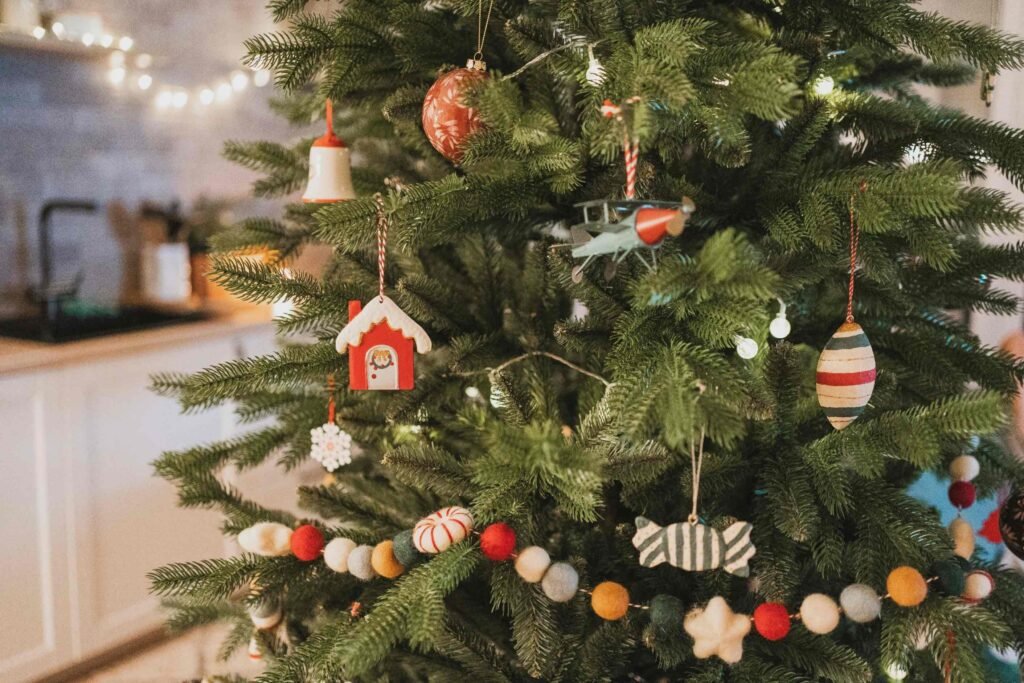
Start with the biggest decorations.5. Place the largest ornaments first
Hang six to ten larger pieces on a typical 6- to 7-foot tree. Spread them in a loose zigzag rather than making a visible spiral. Put some slightly inside the branches, not all at the tips.
It is advisable not to put a single large ornament exactly in the centre of each visible area, since the grid-like arrangementAvoid placing one large ornament at the exact center of every visible section. That grid-like spacing makes a natural tree appear stiff.
6. Repeat the ornamental motifs of the medium ornaments
Now add the main ornament family. Begin by placing one item in each of the major sections next. Start with one piece in each major section of the tree, then only fill the gaps that appear to look accidental.
A good way to test spacing is to hold your open hand between two ornaments. If they’re closer than that across most of the tree, stop and look from across the room before adding more.
7. Add the smallest details last
Put small bells, stars, cones, or wool decorations at the outer ends of the tree since this layer is meant to encourage people to look more closely at the tree rather than altering its total colour.
Although natural cones are attractive, it’s important to properly bake or otherwise prepare any foraged materials before taking them indoors and to check local regulations before collecting them. The cones available in craft stores are the simpler choice.
8. Add one quiet garland, or none
Garland is optional; if the tree already has paper, straw, and glass decorations, then another texture will be unnecessary.
If the branches still seem to be disconnected, use a narrow material such as an unfinished strand of wooden beads, a fine paper chain, thin red cotton ribbon, or a popcorn garland. Hang it loosely, since a deep swag would look traditional or maximalist rather than Nordic.
9. Finish with a simple topper
A paper star, a straw star, a wooden star, or simply a bunch of twigs will do just fine; the topper should match the material theme that is already present on the tree.
Look at the scale of the topper from the doorway. It is a common error to select a topper on the basis of how it looks when held in your hands. When on the tree, a small topper can appear to be lost, whereas a heavy one bends the upper branch and makes the tree look as though it is tired.
10. Ground the base
You can cover the stand with a simple linen cover, a knitted tree skirt, a wooden collar, or a woven basket. If you prefer the appearance of a basket, the following guide explains the differences between woven, fabric, wire, and plastic storage baskets. When choosing a tree base, make sure to check its internal diameter, height, stability, and the availability of access to the water reservoir.
Keep wrapped gifts within the same palette, but don’t make them identical. Kraft paper, matte white paper, fabric ribbon, and cotton string give enough variation without adding visual noise.
Budget vs. premium Nordic ornament plan
The premium version of this tree shouldn’t have twice the amount of decoration; instead, it should make use of better materials and include a few items that you’ll want to unpack for years.
| Element | Budget approach | Premium approach | Where spending makes a difference |
| Lights | One warm-white LED set with a green or clear wire | Dimmable, replaceable-bulb or fine-wire lighting from an established maker | Even color, reliable connections, and easier dimming |
| Paper ornaments | Fold stars and hearts from heavyweight paper | Buy handmade or letterpress paper pieces | Cleaner folds, special papers, and longer life |
| Wood ornaments | Use simple unfinished shapes or make salt-dough alternatives | Choose carved, turned, or painted ornaments from an independent maker | Detail, finish, and keepsake value |
| Straw ornaments | Buy a small multipack and repeat the same two shapes | Collect hand-tied stars, goats, and geometric pieces gradually | Craftsmanship is visible at close range |
| Glass | Thrift plain clear or muted-color baubles | Add a few mouth-blown or hand-painted pieces | Best used as focal ornaments, not filler |
| Garland | Make a paper chain or string wooden beads | Choose wool felt, linen ribbon, or a well-made wooden garland | Natural drape and durable materials |
| Tree base | Wrap the stand in spare linen or adapt a basket you own | Buy a fitted wooden or woven collar | Fit, stability, and a cleaner edge |
| Topper | Cut and fold a large paper star | Choose a sturdy straw, wood, or illuminated paper star | A strong topper can carry an otherwise simple tree |
To achieve the most convincing effect on a small budget, you should spend your money on the lights and make the paper decorations. If you want to make an investment, then buy one unique ornament each year instead of replacing the entire display when fashion changes.
Three easy ornament projects that suit this tree
A complete afternoon devoted to crafting isn’t necessary; it’s sufficient to repeat one handmade item six or eight times.
Accordion paper stars
Take two rectangles of medium-weight paper that are equal in size. Fold each one into an accordion shape, make a crease down the middle, and secure the midpoint using cotton thread. Then open out the ends, join the two halves with a small amount of paper glue, and attach a hanging loop.
To achieve a soft appearance, use off-white paper or, for greater contrast, brown kraft paper. Only produce two sizes, not six, since repetition has a calming effect.
Wooden bead drops
Fasten three beads made of wood and of gradually increasing size onto a cotton cord. Tie a knot under the lowest of the beads and make a loop above the highest one. Leave the beads as they are or paint one of them your accent color.
It is useful to use these drops on branches that are sparse since their vertical shape allows them to make good use of the space without giving the tree a crowded appearance.
Folded heart baskets
Traditional woven paper hearts are created by taking two folded, rounded pieces of paper, cutting them into strips, and then interlacing them to make a small pocket. For best results, use matte papers that contrast with each other so that the weave is visible. After you’ve got a good understanding of how the heart is put together, cream and pale red will form a more subdued pair.
The tree can have a wrapped sweet or a brief handwritten note, which gives it a purpose that goes beyond simply being a decoration.
How to keep a minimal tree from looking bare
The difference between restrained and unfinished is usually repetition.
Imagine a tree with five unrelated ornaments: one red bauble, one paper bird, one glittered snowflake, one wooden house, and one silver bell. There may be plenty of visual interest, but no rhythm. Now imagine the same tree with eight paper stars, eight wooden figures, a dozen plain baubles, and three personal ornaments. It still has open branches, but it looks resolved.
If your tree seems bare, don’t immediately add another material. Try one of these fixes:
- Move a third of the lights closer to the trunk to give the tree depth.
- Repeat your strongest ornament family three to six more times.
- It is better to add two or three bigger ornaments rather than a large number of small ones.
- Put a basket or skirt around the stand so the tree has a clear visual base.
- Place a floor lamp or soft textile nearby to connect the tree to the room.
- Remove one competing decoration from the wall or surface behind it.
The final one is easy to overlook; at times the tree is okay, and it’s the background that’s overdoing it.
Scandinavian Christmas tree ideas for different rooms
Neutral living room
Use paper that is cream in color, pale wood, clear glass, and warm lighting. If necessary, include a few hearts that are a rust red to provide a contrast. Instead of introducing another color, use the same red in the ribbon that is used for the gifts.
Colorful family room
Do not contradict the color scheme of the room; instead, select one color from the rug, the artwork, or the cushions and use it as a highlight for the tree. The rest of the decorations should be wood and white. In this way, the tree will fit in with the room and will not become an additional source of color.
Small apartment
Select a tree that is between four and five feet tall, a tabletop tree, or a branch display. Use flat paper ornaments along with a short fine-wire light set. After Christmas, keep the decorations in a single shallow box. Further suggestions for practical and calm areas can be found in the Home Life section of the site.
Home with children or pets
Place the paper, wood, felt and other non-breakable decorations in the lower third of the tree. Secure the ornaments rather than using sharp metal hooks. Keep the cords in check, secure the tree if there is a risk of it tipping, and put the fragile glass items above reach.
It is advisable to keep the styling simple. Having fewer items towards the lower part reduces the number of temptations and means less frequent rearranging.
Common styling mistakes
Choosing too many neutrals
Cream, beige, taupe, gray, pale wood, dark wood, silver, and gold may all sound neutral, but together they can become muddy. Pick two neutral tones and one wood finish.
Using cool, bright light
Blue-white lights flatten warm materials. Check the package for warm white rather than relying on the product photo.
Hanging everything on branch tips
Decorating the tree with decorations on the surface makes it look like a cone. Put some lights and a few ornaments nearer to the trunk. It is the sense of depth that makes a small number of decorations seem enough.
Making every gap equal
Perfect spacing may seem artificial, so try to achieve a balance throughout the entire tree with some quiet areas and some small groups.
Adding texture without editing
Paper, straw, wood, wool, felt, linen, glass, metal, ribbon, and pine cones can each fit the style. They don’t all need to appear on one tree. Choose three main materials, then allow one or two personal exceptions.
Treating “Scandinavian” as colorless
Red is used in decoration for Christmas in the Nordic countries, as do folk patterns and humorous handmade items; restraint is achieved through repetition and proportion, not by banning color.
A safety note before you switch on the lights
It is not advisable to imitate the traditional Nordic image of real candles being attached to branches. According to the National Fire Protection Association, lit candles should never be used on a Christmas tree, and it is recommended that the tree be kept at a distance of at least three feet from fireplaces, radiators, heat vents, lights, and other heat sources.
Use battery-operated candle lights if you want the upright-candle effect. Check electrical strands before installation, follow the maker’s connection limit, keep cords away from the tree stand’s water, and turn the lights off when you go to bed or leave home.
If the tree is genuine, water it every day and take it out when it has dried. Once the needles have become brittle, there is no point in waiting for one more week just to have a nicely looking tree.

Frequently asked questions
What colors are used on a Scandinavian Christmas tree?
It is usual to mix green with warm white, cream, natural wood, straw, a subdued red, amber, or brushed brass. Select two neutral tones and then one optional accent color. When it comes to color choice, having a limited palette is more important than sticking to any one ‘correct’ color.
How many ornaments should a minimalist tree have?
As there is no set number since both the density of the trees and the size of the ornaments differ, when using a tree that is between 6 and 7 feet tall, start with six to ten large ornaments, 18 to 30 medium ones, and then add a small number in the final layer. Stop decorating when the tree appears to be well balanced when viewed from across the room, and the branches are still visible.
Could a Christmas tree from Scandinavia have red ornaments?
Certainly, things such as silent red paper hearts, painted wooden items, small apples, or a few red glass baubles can give a neutral tree a more traditional appearance, and instead of using a variety of unrelated colors, red should be repeated in small quantities.
What is there for me to use instead of tinsel?
You could use a narrow paper chain, a thin ribbon made of cotton or linen, a string of wooden beads, or perhaps go without a garland altogether. Lights that are warm and ornaments that are repeated might be sufficient.
What is the best topper for a tree in the Nordic region?
A paper, straw, or wooden star is the simplest choice. Pick a topper large enough to be visible but light enough that the upper branch stays straight.
How do I make an artificial tree look more Scandinavian?
Shape every branch, leave intentional gaps, use warm lights at more than one depth, and limit the ornaments to a few natural-looking materials. Hide the stand with linen, wood, or a fitted woven basket.
A tree with room to breathe
The best Scandinavian Christmas tree isn’t the one with the fewest decorations. It is the one where you can tell why each decoration stayed.
Put the lights deep enough to glow, repeat a few honest materials, and leave a little green between them. Then stop while the branches still have something to say.
Sources
- Nordiska museet, “Christmas,” https://www.nordiskamuseet.se/en/traditions-celebrations/christmas/
- National Fire Protection Association, “Christmas Tree Safety,” 2025, https://content.nfpa.org/-/media/project/storefront/catalog/files/safety-tip-sheets/christmastreesafetytips.pdf
- U.S. Consumer Product Safety Commission, “Seasonal and Decorative Lighting Products,” https://www.cpsc.gov/FAQ/Seasonal-and-Decorative-Lighting-Products
- National Christmas Tree Association, “Care Tips,” https://realchristmastrees.org/all-about-trees/care-tips/

Parker is a home and lifestyle writer at The Scandi Home, where they share a love for Scandinavian design, cozy living, and thoughtful interiors. Their writing focuses on simple, functional spaces that feel calm, warm, and lived-in.